
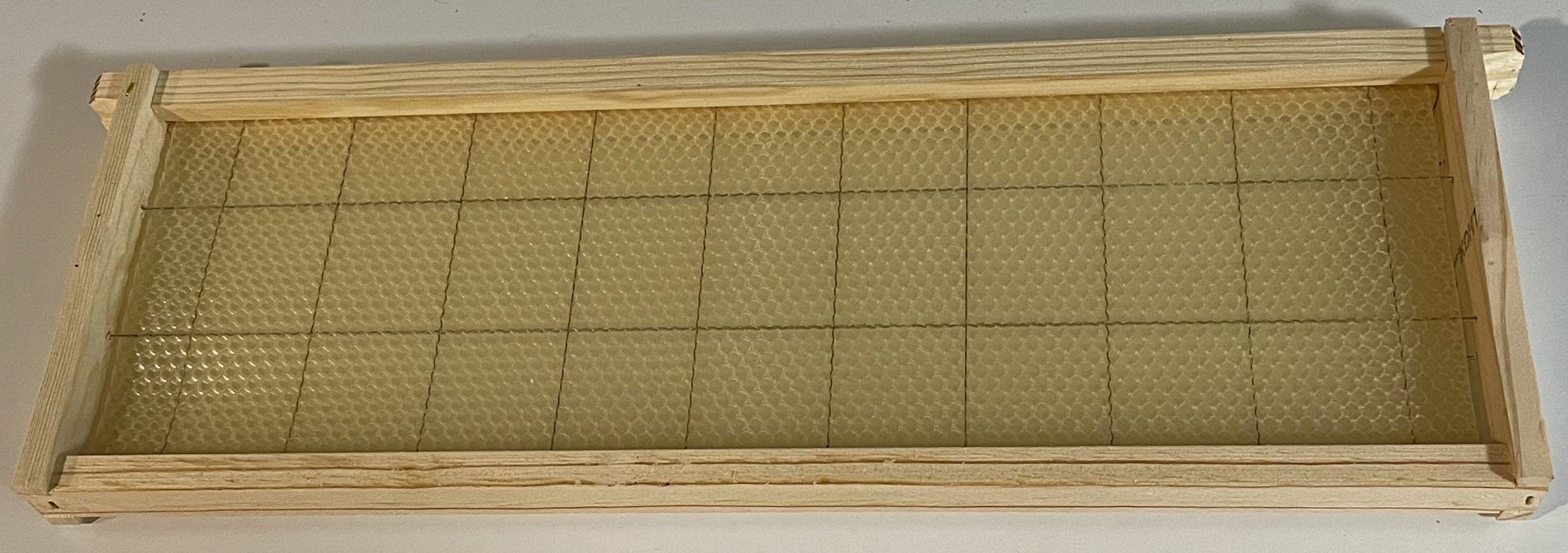
Here is what goes into the making of Allview Bees medium wired wax frames. CLICK HERE to purchase.
The perfect frame is just what the bees want. Foundations are not found in nature however in order to keep bees healthy and happy it is a good thing to give them a great start in an organized hive that is easy for a beekeeper to maintain. In nature bees make their comb hanging from whatever overhead structure they find. It may be in a tree or in an attic! There are also foundationless frames that are used in some beehives by beekeepers. However without a foundation, these hives are hard to work since you cannot tilt the frame too far without the comb simply falling out.
Standard practice for both professional and backyard beekeepers is to use frames with a foundation. Frames are required by US law to be used when keeping bees. This allows for easy inspection and proper maintenance for the reduction of pests and hive diseases.

There is an old addage with beekeepers “Bees will do what ever bees want to do”. Without a foundation as a guide for them they will build their comb in whatever manner seems good for tham at the time. Even with a foundation they will still sometimes make “wacky” choices and build comb in some non-standard manner.
Many beekeepers have an issue with the frame fallng apart when extracting honey from them. The stresses of the extractor are too much for a frame that has not been nailed and glued properly. Unfortunately many beekeeping supply companies sell these frames with out the necessary reinforcement.

While there are several sizes that hive and frames come in, (Deep, medium, shallow) the most common for backyard beekeeping is the medium. This is true even if a ‘deep’ is used to raise brood, medium frames are used for the upper ‘honey supers’ simply because a deep frame or box of frames becomes too heavy for the average beekeeper to deal with. Bees normally store extra honey at the top of the hive so this is where it is desirable to have medium or even shallow frames.

Wood vs Plastic? This can be a rather subjective question. Plastic foundations or even complete plastic frames are offered by many beekeeping suppliers. I have not seen any price advantage with plastic. Also since bees prefer to build on beeswax foundations, plastic has to be coated with beeswax prior to use. Since bees do what bees do, many times they want to make a hole through the frame. This hole may be for communication or easy access to the other side. Some plastic foundations have a tab on one corner that you can break off for the bees. Last of all but still an important consideration: Where will that plastic foundation end up after it’s useful life in the hive? Will it be taking up space in a landfill someplace or end up in the ocean with all the rest of the disposed plastic?

Wood and beeswax foundation are my choice. I started making my frames in 2020 and I have always been looking for ways to improve on my process efficiency, quality and pricing. I buy the wooden parts and foundation in bulk pre cut from Mann Lake and assemble them myself. First I insert the grommets in the side pieces then I use a frame jig where I can glue and nail 10 frames at a time. I use the highest quality glue and apply it to both sides of each joint. The joints are then nailed left to cure for more than 24 hours. Next I thread the horizontal wires in to the frames making sure that the wire ends do not stick out and create a poking hazard. Lastly I trim the foundation for the best fit and melt the horizontal wires into it. I then shrink wrap 5 frames in a bundle and they are ready for the beekeeper to purchase.
I am still using frames that I made in 2020. The joints simply cannot be broken. However I can put new wax in the old frames and keep using them.

Leave a Reply